
Government Debt and the Price of Capital: Why the Source of Financing Matters

I. Introduction: The Debt Number Is Only the Beginning
Government debt is usually discussed as a quantity. Debt-to-GDP ratios rise or fall, deficits widen or narrow, and fiscal projections are evaluated according to whether public liabilities appear sustainable over time. These measures are indispensable. Yet they are incomplete guides to the financial consequences of government borrowing.
The missing question is straightforward: who ultimately provides the capital?
Two governments can run deficits of similar size while placing very different demands on financial markets. In one economy, households and corporations may be saving heavily, leaving domestic balance sheets with substantial capacity to absorb additional public securities. In another, private saving may be weak and the government may need to attract incremental financing from abroad. The fiscal numbers can look similar even though the underlying financing conditions differ considerably.
This distinction helps explain an apparent puzzle of the past several decades. Across advanced economies, government debt rose substantially after the global financial crisis and again during the pandemic. Yet long-term interest rates did not rise mechanically alongside debt. In some periods, exceptionally large fiscal deficits coincided with relatively modest movements in sovereign yields. Japan presents an even more striking case: an exceptionally high public debt ratio has coexisted for long periods with low borrowing costs and a strong external asset position.
None of this implies that debt is costless or that fiscal sustainability has ceased to matter. It suggests something more limited and more useful for decision-making: the interest-rate consequences of public borrowing depend partly on the balance sheet of the economy surrounding the government.
Debt therefore needs to be evaluated within a broader system that includes private saving, current-account balances, international asset positions, investor structure, and the capacity of domestic financial institutions to absorb additional securities.
For policymakers, investors, corporate executives, and financial institutions, this changes the analytical question. The relevant issue is no longer simply how much a government is borrowing. It is how that borrowing interacts with the supply of savings available to finance it.
II. From Government Borrowing to National Borrowing
A fiscal deficit represents government dissaving. But the government is only one sector of the economy.
Households save. Corporations retain earnings. Financial institutions allocate accumulated wealth. When these private-sector balances move in the opposite direction from the government balance, a large fiscal deficit need not translate into an equally large increase in the country's total demand for foreign capital.
The relationship can be understood without elaborate accounting.
A country's external financing position reflects, broadly, the combined saving behavior of its public and private sectors. If the government moves deeper into deficit while households and companies increase saving by a comparable amount, national saving may change relatively little. If private saving fails to increase, however, the fiscal deterioration is more likely to appear as a larger current-account deficit and greater reliance on foreign capital.
This distinction was especially visible during major global shocks. Around both the 2008 financial crisis and the 2020 pandemic, fiscal deficits increased sharply across many advanced economies. At the same time, private-sector saving also rose. In the United States, for example, exceptionally large government borrowing during those episodes was partly offset by increased private saving. By contrast, the mid-2000s combined government deficits with weak private-sector saving and a much larger current-account deficit.
The implication is important.
A fiscal deficit does not by itself reveal how much additional capital an economy needs to obtain from the rest of the world.

Consider two countries, each running a fiscal deficit equal to 5 percent of GDP. In the first, the private sector generates net saving equal to 8 percent of GDP. In the second, private saving is negligible. The fiscal position is identical, but the aggregate financing environment is not. The first economy may still be exporting capital on net. The second may need substantial external financing.
Financial markets ultimately price the entire configuration.
This is why government debt should be analyzed alongside national saving rather than in isolation. The amount of public borrowing remains important, but so does the pool of capital available to absorb it.
A government that can draw on abundant domestic saving has a different marginal financing problem from one that must continuously persuade foreign investors to increase their exposure.
III. Why the Source of Financing Changes the Interest-Rate Effect
Government borrowing can affect interest rates through several channels.
The first is the familiar crowding-out channel. When the government demands more financing from a limited pool of savings, the price of that financing may rise. Higher government borrowing can compete with business investment, household credit, and other uses of capital. The stronger the competition for funds, the greater the potential upward pressure on interest rates.
The second operates through portfolio balance. Investors do not have unlimited demand for government securities at any price. As the stock of bonds grows, investors may require higher yields to hold additional duration, particularly when their existing portfolios are already heavily exposed to sovereign debt. The adjustment may be small when domestic savings are plentiful and investor demand is deep. It can be larger when governments need to reach increasingly price-sensitive investors.
A third channel involves macroeconomic expectations. Fiscal expansion can affect expectations for growth, inflation, and monetary policy. If market participants expect stronger demand or more persistent inflation, nominal yields can rise even before the additional borrowing is completed. If fiscal policy is expected eventually to require tighter monetary policy, the effect can extend across the yield curve.
A fourth concerns risk and credibility. The market's assessment of debt sustainability, refinancing needs, institutional quality, currency risk, and fiscal flexibility influences the compensation investors demand. This mechanism is particularly important when borrowing occurs in an environment of weak external balances or declining confidence.
Domestic saving can moderate several of these pressures.
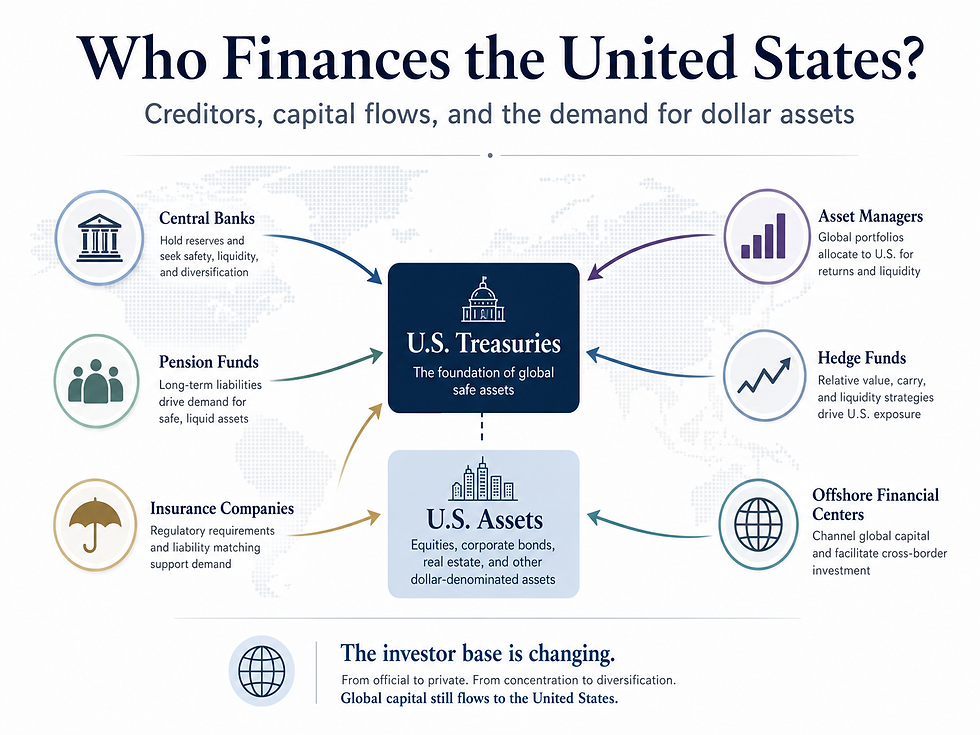
When households, corporations, pension funds, insurers, banks, and other domestic investors possess substantial financial surpluses, additional government issuance may be absorbed with relatively limited changes in required returns. Domestic institutions may also have structural reasons to hold sovereign securities, including liquidity management, regulatory requirements, liability matching, and collateral needs.
Foreign financing can be different at the margin. International investors compare opportunities across countries, currencies, maturities, and asset classes. Additional borrowing may therefore require a yield adjustment, a currency adjustment, or both before external balance sheets are willing to absorb it.
This should not be interpreted as a claim that domestic investors are insensitive to price or that foreign investors are inherently unstable. Both groups respond to incentives and risk. The point is narrower: the elasticity and composition of the available investor base matter for the price at which new government debt can be placed.

A sovereign bond yield is therefore partly a fiscal price and partly a balance-sheet price.
IV. The External Balance as Part of Fiscal Capacity
The analysis becomes more informative when it moves from annual financing flows to accumulated national balance sheets.
A country can be a net international creditor, owning more foreign assets than foreigners own claims on it, or a net international debtor, with the reverse position. This distinction says something important about the economic environment in which the government borrows.
A net creditor economy possesses accumulated claims on the rest of the world. Its residents, taken together, have previously saved more than they invested domestically and have built foreign assets. When its government needs to borrow more, the economy may have greater capacity to redirect some of those savings toward domestic public securities without immediately increasing dependence on external capital.
A net debtor is starting from a different position. Additional government borrowing that is not matched by additional domestic saving may further increase external financing requirements. The marginal investor may increasingly be located abroad, and the country may become more exposed to changes in global risk appetite, exchange rates, or international interest-rate conditions.
Empirical evidence across advanced economies supports this distinction. The estimated effect of additional government borrowing on long-term interest rates is generally smaller for net international creditors than for net international debtors, and smaller when borrowing is financed through domestic savings rather than additional foreign borrowing.
This leads to a broader conception of fiscal capacity.
Fiscal space is often described in terms of government variables: debt ratios, deficits, interest expenditures, tax capacity, maturity structure, or the currency denomination of liabilities. All remain important. But the financing environment adds another dimension.
A country with a deep domestic investor base, high private saving, a strong external position, and credible institutions may be able to carry a given debt ratio at a lower interest cost than another country with the same debt ratio but a weaker national balance sheet.
Debt ratios therefore should not be interpreted as universal thresholds.
A ratio that is manageable under one financing structure can become difficult under another. The relevant constraint is not only the stock of debt but also the price at which the next unit of debt can be financed.
V. What the Evidence Tells Us
The magnitude of this distinction can be seen in cross-country estimates of the relationship between expected fiscal conditions and long-term interest rates.
The evidence does not support a single coefficient that applies uniformly across countries. Instead, the interest-rate effect varies along a continuum determined partly by the country's external position and the source of financing.
For gross government debt, a 1-percentage-point increase in the debt-to-GDP ratio is associated with an estimated increase of roughly 0.7 basis points in the 10-year interest rate for a representative net creditor, rising toward approximately 1.2 basis points for a representative net debtor financing the increase through foreign borrowing. The corresponding effects on the five-year rate expected five years ahead are larger, ranging from roughly 1.1 to 2 basis points.
The effects associated with fiscal deficits are more pronounced. A 1-percentage-point increase in the overall budget deficit as a share of GDP produces an estimated increase in the 10-year yield of roughly 8.5 basis points for a net creditor financing domestically, compared with about 16 basis points for a net debtor financing abroad. For longer-horizon forward rates, the estimated range rises to approximately 15 to 21 basis points.

The precise numbers should be interpreted cautiously. They are statistical estimates derived from cross-country relationships, not immutable laws of financial markets. Interest rates also respond to inflation expectations, growth expectations, monetary policy, global financial conditions, regulation, safe-asset demand, demographics, and many other forces.
The larger point is more robust.
Across specifications, the estimated marginal interest-rate impact of additional debt or deficits for a net creditor financing domestically is roughly half that for a net debtor relying on foreign financing.
That difference is economically meaningful.
Suppose two governments announce fiscal expansions of similar size. Looking only at their debt trajectories may suggest similar consequences for bond yields. Yet if one economy has high private saving and a strong international asset position while the other has low saving and substantial foreign liabilities, the market may respond differently.
The distinction also helps explain why attempts to infer interest rates directly from debt ratios often disappoint. There is no stable one-to-one mapping between the two variables.
Debt matters, but it matters within a financial system.
VI. Japan, the United States, and the Importance of Private Saving
Japan illustrates the importance of separating the government's balance sheet from the national balance sheet.
Its public debt is extraordinarily large relative to GDP. Yet Japan has also maintained high private-sector saving and accumulated a substantial net foreign asset position. Government deficits have therefore existed alongside current-account surpluses for much of the period since the mid-1990s. Japan has been able to combine very high gross public debt with the position of a net international creditor.
This does not make the fiscal position irrelevant. Demographic change, higher interest rates, declining household saving, or shifts in institutional portfolios could alter the financing environment over time. The Japanese case instead demonstrates that public debt alone does not describe the balance-sheet capacity of an economy.
The United States provides a different illustration.
During the 2008 financial crisis and the 2020 pandemic, government deficits widened dramatically. Under a simple crowding-out story, such fiscal expansions might have been expected to produce correspondingly large increases in the nation's demand for foreign financing. But private saving rose sharply at the same time, offsetting much of the increase in public-sector borrowing.
The contrast with the mid-2000s is revealing. Between roughly 2004 and 2007, U.S. fiscal deficits were far smaller than during the major crisis episodes, yet weak private saving contributed to a current-account deficit of around 6 percent of GDP. The economy's dependence on foreign financing was therefore greater even though the government's own deficit was less dramatic.
These examples demonstrate why fiscal analysis benefits from examining sectoral balances together.
A government can increase borrowing while the country's external financing requirement remains broadly stable. It can also run a comparatively moderate deficit while the nation as a whole becomes increasingly dependent on foreign capital.
The direction of private saving determines much of the difference.

This perspective also changes how fiscal expansions during recessions should be interpreted. Private investment often weakens and precautionary household saving may rise during severe downturns. Government borrowing can therefore increase precisely when private demand for financing is falling or private saving is increasing. Under those circumstances, the pressure on interest rates may be smaller than a fiscal deficit viewed in isolation would imply.
The situation can reverse during an expansion. Strong private investment, declining household saving, and large government deficits can place simultaneous claims on the same pool of capital.
The economic effect of fiscal policy therefore depends partly on the environment into which it is introduced.
VII. What Decision-Makers Should Watch
For policymakers, the practical implication is that fiscal surveillance should extend beyond the government budget.
The debt-to-GDP ratio remains essential, but it should be considered together with the current-account balance, private-sector saving, the net international investment position, debt maturity, the composition of the investor base, and the proportion of government securities held abroad.
These indicators help reveal whether additional government borrowing is being absorbed through domestic portfolio adjustment or increasing the economy's reliance on foreign capital.
For central banks, the distinction matters because fiscal policy does not exert a uniform influence on financial conditions. A given increase in government issuance may create limited yield pressure in an economy with abundant domestic saving, while a similar increase elsewhere could meaningfully tighten long-term financing conditions. The fiscal-monetary interaction therefore depends partly on the financing structure.
For corporate executives, sovereign financing conditions are not a distant macroeconomic concern.
Government bond yields provide reference rates throughout the financial system. Persistent upward pressure on sovereign yields can feed into corporate borrowing costs, project hurdle rates, mortgage rates, bank funding costs, and asset valuations. Governments and companies can therefore compete indirectly for the same savings.
A corporate investment that appears attractive when the risk-free rate is 2 percent may not clear the required return when government borrowing contributes to a sustained repricing of long-duration capital.
Exchange rates create another channel. A country increasingly dependent on foreign financing may need either higher yields or currency adjustment to attract capital. Businesses with foreign-currency liabilities, imported inputs, or cross-border revenues can be affected well before fiscal stress becomes visible in conventional debt-sustainability measures.
For investors, sovereign analysis should similarly move beyond ranking countries by debt ratios.
A more complete dashboard would include public debt, the primary balance, interest expense, refinancing requirements, private saving, the current account, the net international investment position, foreign ownership of government bonds, domestic institutional investor capacity, and the currency composition of liabilities.
None of these variables is sufficient alone.
Together, however, they reveal something more important than the headline debt number: the structure through which the debt is financed.

VIII. Domestic Financing Is a Buffer, Not a Free Pass
The existence of a strong domestic investor base should not be confused with unlimited fiscal capacity.
Domestic saving is not fixed.
Population aging can reduce household saving as retirees draw down accumulated assets. Corporations can move from financial surpluses to investment deficits. Pension funds and insurers can change asset allocation. Banks can encounter capital, liquidity, or concentration constraints. Investors can shorten duration or demand higher compensation for inflation risk.
Private investment can also recover.
When businesses increase capital expenditure, the amount of domestic saving available to finance the government without competition may decline. Government borrowing that was easily absorbed during a recession may exert greater upward pressure on yields during a strong expansion.
External positions can change as well. Persistent fiscal deficits that are not matched by private saving can gradually weaken the current account and accumulate foreign liabilities. A country that begins with a favorable financing structure can therefore migrate toward a less favorable one.
There is also a fiscal feedback mechanism.
As debt rises, higher interest rates increase government interest expense. Larger interest payments widen the overall deficit unless offset elsewhere. That increases future borrowing requirements, which can place further pressure on yields. The process becomes more consequential when a large share of the debt stock must be refinanced at higher rates.
The advantage of domestic financing should therefore be understood as a buffer.
It can reduce the marginal interest-rate effect of additional borrowing and provide governments with greater room to respond to temporary shocks. But it does not repeal the government's intertemporal budget constraint. Cross-country evidence showing lower near- and medium-term interest-rate effects under favorable financing conditions does not diminish the importance of long-run fiscal sustainability.
A resilient fiscal position ultimately requires both access to financing and confidence that the debt trajectory can be stabilized.
IX. Conclusion: Debt Must Be Read Through the Balance Sheet
Government debt remains one of the central variables in macroeconomic and financial analysis. But the debt ratio is better understood as the beginning of the inquiry than as its conclusion.
The same amount of government borrowing can have different effects on interest rates depending on whether it is absorbed by domestic saving or requires additional foreign capital. The consequences can differ further depending on whether the economy as a whole is a net international creditor or debtor.
This perspective provides a more coherent explanation for why very large fiscal expansions have sometimes produced less upward pressure on interest rates than conventional intuition might suggest, while smaller fiscal imbalances can become consequential when they coincide with weak private saving and external dependence.
For decision-makers, four questions therefore deserve to accompany every discussion of public debt:
Who is financing the government? Where are those savings coming from? What is the country's broader external balance-sheet position? And how durable is that financing structure if economic conditions change?
The answers matter for governments deciding how much fiscal space they possess, for central banks assessing financial conditions, for companies setting investment and financing strategies, and for investors pricing sovereign risk.
Government borrowing does not occur in isolation. It takes place inside a national and global system of balance sheets.
Understanding the price of public debt requires understanding that system.


Comments