
The Changing Structure of U.S. External Financing: Creditors, Capital Flows, and the Demand for Dollar Assets
I. Introduction: The Question Behind America’s External Financing
The United States occupies an unusual position in the global financial system. It is the issuer of the world’s dominant reserve currency, home to the deepest capital markets, and the provider of securities that serve simultaneously as investment assets, liquidity instruments, collateral, and reserves. At the same time, it has operated for decades with persistent current account deficits and has accumulated a large negative net international investment position.
These characteristics have long coexisted without producing the external financing constraints that would typically confront a large debtor economy. Global investors have continued to hold U.S. assets at scale. Foreign central banks have accumulated dollar reserves. Private institutions have treated U.S. Treasury securities as a core component of global portfolios. During periods of financial stress, capital has frequently moved toward the United States rather than away from it.
That resilience remains substantial. But the structure underlying it is changing.
At the end of 2025, the U.S. net international investment position exceeded negative 70 percent of GDP. The deterioration cannot be interpreted simply as the cumulative result of excessive borrowing. Much of it reflects valuation effects: the exceptional performance of U.S. equities has increased the market value of American assets held by foreign investors, while dollar appreciation has reduced the dollar value of many foreign assets held by U.S. residents. Persistent borrowing nevertheless remains important, particularly through debt securities.
The central question is therefore broader than whether the United States owes too much to the rest of the world. It is who finances the United States, through which instruments, for what reasons, and under what conditions those investors might change their behavior.
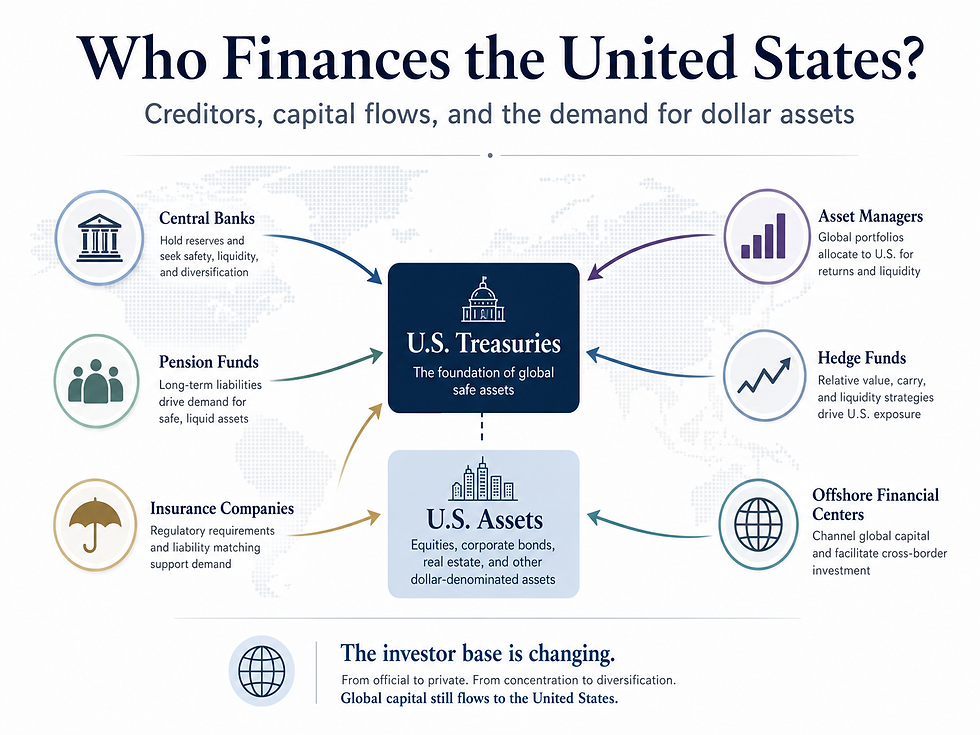
That distinction matters because creditors are not interchangeable. A central bank managing foreign exchange reserves has different objectives from a pension fund seeking duration, an asset manager constructing a global bond portfolio, or a leveraged fund exploiting relative-value opportunities. The same quantity of foreign financing can therefore imply very different market dynamics depending on who provides it.
For decision-makers, this shift has implications well beyond the Treasury market. The price at which the United States attracts global capital influences sovereign yields, corporate borrowing costs, mortgage rates, exchange rates, financial conditions, and ultimately the discount rates applied to assets throughout the world.
Understanding America’s creditors is increasingly part of understanding the global cost of capital.
II. A Larger Debtor Position Does Not Tell the Whole Story
The scale of the U.S. external position is striking. Yet headline measures of net foreign liabilities can obscure as much as they reveal.
A country’s net international investment position records the difference between the value of financial assets its residents own abroad and the value of domestic assets owned by foreigners. Changes in that position arise from two fundamentally different sources. One is financial flows: borrowing, lending, and cross-border investment. The other is valuation: changes in equity prices, bond prices, exchange rates, and the market value of existing assets.
For the United States, valuation effects have become unusually important.
American companies represent a large share of global equity capitalization. Foreign investors consequently hold substantial positions in U.S. equities. When American stock prices rise faster than markets elsewhere, the market value of those foreign claims on the United States rises as well. Statistically, the U.S. external position becomes more negative even though the change may reflect an increase in the value of American companies rather than a new financing transaction.
Exchange rates reinforce the effect. Many U.S. investments abroad are denominated in foreign currencies, while a large share of U.S. liabilities to foreigners are denominated in dollars. When the dollar appreciates, the dollar value of foreign assets owned by Americans declines, while dollar-denominated U.S. liabilities do not receive an equivalent downward adjustment.
The result is a balance sheet in which a worsening net position does not necessarily indicate a comparable increase in underlying financial vulnerability. The composition of that position matters.

Equity liabilities and debt liabilities behave differently under stress. Foreign ownership of American equities creates a degree of international risk sharing. If U.S. stock prices decline sharply, part of the associated wealth loss is borne by foreign shareholders. The value of U.S. external liabilities falls automatically.
Debt does not adjust in the same way. Interest and principal obligations remain. When market rates rise, the cost of refinancing debt increases over time. A larger external debt stock can therefore transmit higher interest rates directly into the country’s income balance and financing requirements.
This distinction has become more important as higher interest rates have already eliminated the positive U.S. investment-income balance that persisted even while the country was a net debtor. That surplus had reached about 1.4 percent of GDP in 2017. By the middle of the 2020s, the combination of larger net liabilities and higher interest costs had removed that cushion.
The relevant vulnerability is therefore not captured by a single number such as net foreign liabilities relative to GDP. The more useful questions concern the form of those liabilities, their financing costs, and the willingness of investors to continue absorbing them.
In that respect, bonds—and particularly Treasury securities—deserve more attention than the headline external position alone would suggest.
III. Who Actually Owns America’s Liabilities?
Identifying America’s creditors sounds straightforward. In practice, the architecture of modern finance makes it increasingly difficult.
Conventional international financial statistics generally classify an investor according to the residence of the entity through which an investment is held. That framework worked reasonably well when cross-border portfolios were more directly connected to domestic institutions. It becomes less informative when assets are held through global custodians, investment funds, offshore vehicles, and multinational financial groups.
A Treasury security recorded as being held in the Cayman Islands, for example, may ultimately belong to investors in the United States, Japan, Europe, or elsewhere. Securities recorded in Belgium may be held through Euroclear on behalf of investors located in other jurisdictions. Positions attributed to the United Kingdom may reflect the role of London as a center for global asset management rather than the balance sheet preferences of British households or institutions.
Ireland and Luxembourg present similar challenges because of their large investment-fund sectors.
This creates an important distinction between the immediate location of an asset and the identity of the investor ultimately bearing its economic risk.
The growth of cross-border financial intermediation has therefore produced a paradox. Global financial positions are measured in greater detail than at almost any previous point in history, yet the ultimate ownership and behavioral characteristics behind some of those positions have become harder to determine.

That uncertainty has practical consequences.
A portfolio held by an unleveraged pension institution may remain relatively stable during periods of market volatility. An identical portfolio held by a leveraged fund may be much more sensitive to repo conditions, margin requirements, volatility, and changes in the relative pricing of securities. Looking only at the nationality recorded in custody statistics can therefore conceal economically meaningful differences in behavior.
The expansion of Cayman-based investment structures illustrates the problem particularly clearly. Reconstructing ownership through fund and regulatory data indicates that a significant portion of Treasury holdings associated with the Cayman Islands reflects investment activity that traditional statistics had not fully captured. The adjustment materially increases the estimated role of foreign private investors, particularly leveraged funds, in the Treasury market.
For policymakers and market participants, the implication is straightforward: knowing how much foreign capital owns U.S. assets is increasingly insufficient. The structure through which that capital is intermediated matters as well.
IV. From Central Banks to Private Capital
Perhaps the most consequential change in U.S. external financing is the transformation of the foreign Treasury investor base.
During the 2000s, a large share of foreign demand for U.S. government debt came from official institutions. Emerging economies accumulated substantial foreign exchange reserves, often as a consequence of export surpluses, exchange-rate management, or precautionary policies following earlier financial crises. Because the dollar was—and remains—the principal reserve currency, a significant portion of those reserves was invested in U.S. government securities.
The mechanism created a durable financial relationship. Current account surpluses outside the United States generated reserve accumulation; reserve accumulation generated demand for Treasuries; and that demand helped finance U.S. external and fiscal deficits.
That structure has weakened considerably.
Foreign investors still hold an important share of the Treasury market—close to 40 percent of outstanding Treasury securities at the end of 2024—but the composition of those foreign holdings has shifted from official institutions toward private investors.

China illustrates the first side of the transition. Its share of outstanding Treasury securities has fallen substantially from the levels reached around the beginning of the 2010s. This reflects both changes in reserve management and a broader diversification of China’s external portfolio.
Japan presents a different case. Its Treasury holdings have been comparatively stable in nominal terms over long periods, but the U.S. Treasury market has grown much faster. Consequently, Japan’s percentage share has declined even without a corresponding collapse in its absolute holdings.
Meanwhile, the relative importance of the euro area, the United Kingdom, the Cayman Islands, and other financial centers has increased. The rise of the Cayman Islands becomes particularly significant once previously undercounted hedge-fund positions are included.
By mid-2025, estimated foreign private holdings of Treasury securities, including the adjustment for Cayman-based positions, reached approximately $6.7 trillion. Foreign official holdings stood at roughly $3.9 trillion. Even allowing for imperfections in the classification of official assets held through financial centers, the change is substantial.
This should not be interpreted as evidence that the world is abandoning U.S. government debt. The data point instead to a recomposition of demand.
Foreign demand remains large. The investors supplying it are changing.
That distinction is important because the motivations behind reserve accumulation differ from those behind private portfolio allocation. A reserve manager may hold Treasuries because they provide liquidity, currency intervention capacity, and a reliable store of official foreign assets. A private investor evaluates them in relation to yield, duration, volatility, hedging costs, collateral value, funding conditions, and expected returns relative to competing assets.
The United States remains capable of attracting global capital. Increasingly, however, that capital must be attracted through market incentives rather than absorbed automatically through the reserve-accumulation cycle that characterized an earlier period.
V. Why Official Demand Has Weakened
Several forces help explain why official foreign demand for Treasury securities has declined.
The first is the slowdown in global reserve accumulation.
During the 2000s, foreign exchange reserves expanded rapidly relative to the world economy. Large current account surpluses, managed exchange rates, commodity revenues, and precautionary reserve accumulation produced a steady flow of official capital into major reserve assets.
That process has moderated. Without comparable growth in the global stock of reserves, central banks have less need to acquire Treasury securities simply to maintain their existing portfolio allocations.
The second factor is the Federal Reserve’s own balance sheet.
Large-scale asset purchases following the global financial crisis and again during the pandemic substantially increased the Federal Reserve’s holdings of Treasury securities. When the central bank absorbs a larger share of the market, the amount available to other investors is mechanically reduced. Over time, changes in the Federal Reserve’s Treasury portfolio therefore interact with changes in foreign ownership.
The third factor is less intuitive: a stronger dollar can reduce, rather than increase, the need for reserve managers to purchase dollar assets.
Central banks generally manage reserves across currencies. If the dollar appreciates substantially against the euro, yen, sterling, or other reserve currencies, the dollar share of an existing portfolio rises even in the absence of new Treasury purchases. A reserve manager seeking to keep currency weights relatively stable may respond by acquiring fewer dollar assets or reallocating toward other currencies.
The historical relationship is visible in the decline of the foreign official Treasury share as the dollar strengthened over the past decade.
A fourth factor is increasingly strategic.
Reserve management has never been completely detached from geopolitics, but the financial consequences of geopolitical alignment have become more salient as sanctions, investment restrictions, trade measures, and economic-security policies have expanded. Evidence increasingly suggests that greater geoeconomic fragmentation is associated with weaker official demand for U.S. Treasury securities.
This does not imply a rapid displacement of the dollar. Reserve currencies benefit from powerful network effects, and there are few markets capable of matching the depth, liquidity, legal infrastructure, convertibility, and supply of high-quality assets available in the United States.
But reserve-currency dominance and marginal demand are different questions.
The dollar can remain dominant while foreign central banks become less important buyers of newly issued Treasury debt. Unless global reserve accumulation accelerates materially or dollar depreciation creates a need for reserve managers to rebuild their dollar allocations, official Treasury demand may remain below the levels that characterized the 2000s.
That changes who must absorb the next dollar of U.S. debt.

VI. Private Demand Changes the Nature of the Risk
Private investors have filled much of the space left by declining official demand, and there are strong structural reasons why they may continue to do so.
The Treasury market possesses characteristics that are difficult to replicate elsewhere. It combines exceptional scale with high liquidity across maturities. Treasury securities serve as benchmarks for pricing other assets, collateral in secured funding markets, liquidity reserves for financial institutions, and core holdings in fixed-income portfolios.
Global portfolio diversification has also increased. As investors have become more willing to hold bonds issued outside their home countries, the largest and most liquid sovereign debt market has naturally captured part of that allocation.
Private foreign demand should therefore not be treated as temporary or inherently fragile.
But it changes the way risk must be understood.
Central banks generally manage reserves according to policy objectives and institutional mandates. Their investment horizons can be long, and their portfolios are not usually governed by the same mark-to-market constraints facing leveraged investors.
Private institutions respond more directly to prices.
A pension fund may reconsider its Treasury allocation as real yields change. An insurance company may adjust duration as its liabilities evolve. A global asset manager may alter exposures according to relative valuations and currency-hedging costs. A bank may change holdings in response to balance-sheet constraints. A hedge fund may hold a large gross Treasury position as one side of a leveraged relative-value trade rather than because it wants long-term exposure to U.S. sovereign credit.
These investors can collectively provide enormous demand. Their behavior is also more heterogeneous.
This matters particularly when leverage enters the system. Treasury-market disruptions in March 2020 demonstrated how positions that appear liquid under normal conditions can be rapidly unwound when volatility rises, financing conditions tighten, and investors seek cash simultaneously. The growing role of leveraged nonbank intermediaries therefore creates a different form of vulnerability from the reserve-management model of earlier decades.
Private demand nevertheless retains an important stabilizing characteristic. Historically, foreign private investors have tended to increase their Treasury holdings during global risk-off episodes. The conventional safe-haven mechanism therefore remains visible: heightened uncertainty can raise demand for U.S. government securities even when expected returns on risk assets deteriorate.
The emerging structure is consequently neither clearly safer nor clearly more dangerous.
It is more market-dependent.
The resilience of U.S. financing increasingly depends on whether yield, liquidity, collateral value, institutional credibility, and the dollar’s global role remain sufficient to attract private capital across a wide range of market conditions.
VII. When Safe Assets Stop Behaving the Same Way
For decades, one of the most valuable features of the U.S. financial system has been its behavior during crises.
A deterioration in global risk sentiment has often produced a familiar sequence. Investors reduce exposure to risky assets, increase demand for Treasuries and dollars, Treasury yields decline, and the dollar appreciates.
For the United States, that mechanism provides an unusual macroeconomic advantage. Stress that weakens economic activity can simultaneously lower the government’s financing cost. The market effectively supplies accommodation at precisely the moment when fiscal and monetary authorities may need greater room to respond.
This behavior is one component of what has historically distinguished the United States from ordinary debtor economies.
The more difficult question arises when uncertainty originates not from the global economy broadly, but from confidence in U.S. policy itself.
Market movements surrounding the U.S. tariff announcements in April 2025 offered an unusual example. Instead of the conventional combination of a stronger dollar and lower long-term Treasury yields during heightened uncertainty, the dollar weakened while long-term U.S. interest rates rose. A single episode is insufficient to establish a structural break, but the combination was notable because it differed from the safe-haven pattern observed during many earlier crises.

The distinction deserves attention.
If investors are worried about a banking crisis in another country, Treasuries may appear safer by comparison. If the shock concerns U.S. fiscal credibility, institutional predictability, trade policy, inflation risk, or the reliability of dollar assets themselves, the same portfolio response cannot automatically be assumed.
This does not mean Treasury securities have ceased to function as safe assets. Their liquidity, collateral role, and institutional importance remain deeply embedded in global finance.
The relevant issue is one of degree.
If official demand becomes structurally weaker and marginal private buyers become more price-sensitive, a larger change in yields may be required to clear the market when Treasury supply rises. If investors also demand additional compensation during episodes of U.S.-originated uncertainty, long-term rates could become more volatile and less reliably countercyclical.
That possibility matters because the U.S. external balance sheet is now much larger than it was during earlier periods of global stress. Higher yields affect federal interest expense, domestic credit conditions, asset valuations, and the income paid to foreign holders of U.S. debt.
The safe-haven mechanism need not disappear to become less powerful.
Even a partial weakening would alter the transmission of global shocks.
VIII. What Decision-Makers Should Watch
For decision-makers, the most useful approach is not to forecast the end of dollar dominance or to assume its indefinite continuation. The more practical task is to monitor the mechanisms that sustain demand for U.S. assets.
The first is the composition of incremental Treasury demand.
The distribution of the existing debt stock matters, but marginal buyers determine market prices. As Treasury issuance expands, attention should focus on which institutions are absorbing the new supply and whether that absorption requires materially higher yields.
The second is the balance between official and private flows.
A continued decline in central-bank demand is manageable if private investors expand their holdings under orderly market conditions. The risk would increase if weaker official demand coincided with reduced willingness among private institutions to extend duration or expand dollar exposure.
The third is the interaction between the dollar and reserve portfolios.
Dollar appreciation can strengthen the currency’s apparent position in global reserves while simultaneously reducing the need for central banks to purchase additional dollar assets. Reserve shares should therefore be interpreted together with valuation effects and actual transaction flows.
The fourth is Treasury-market intermediation.
The presence of investment funds, hedge funds, repo financing, basis trades, and other leveraged strategies means that gross Treasury demand can coexist with underlying liquidity risk. Regulators and market participants need to understand not only who owns the securities, but how those positions are financed and how rapidly they could be unwound.
The fifth—and perhaps most informative—is how Treasuries behave during shocks originating in the United States.
Periods of policy uncertainty offer a real-time test of the safe-asset mechanism. If Treasury prices continue to rise and the dollar strengthens when uncertainty increases, the traditional stabilizing relationship remains powerful. If yields rise and the currency weakens instead, the information content is different.
For corporate executives, these developments matter through borrowing costs, capital budgeting, currency exposure, and hedging decisions. A sustained increase in Treasury term premiums ultimately raises the hurdle rate for corporate investment well beyond the United States.
For financial institutions, the consequences extend to liquidity management, collateral valuation, duration risk, repo markets, and the interaction between sovereign securities and leveraged balance sheets.
For investors, the issue concerns portfolio construction. Relationships among Treasuries, the dollar, equities, credit, commodities, and foreign bonds that worked reliably in earlier regimes may become less stable if the identity and behavior of marginal Treasury buyers change.
For policymakers, the lesson is equally important. Debt sustainability is influenced by fiscal arithmetic, but fiscal arithmetic itself depends on financing conditions. A country issuing the global reserve currency has considerably more financing capacity than a conventional debtor. That capacity is nevertheless mediated through institutions, markets, and investor confidence.
And for decision-makers outside finance, the subject is still relevant. U.S. Treasury yields form part of the foundation on which global asset prices are built. Changes in the market’s willingness to finance the United States eventually affect infrastructure projects, technology investment, real estate, mergers and acquisitions, emerging-market financing, pension liabilities, and the valuation of long-duration business models.
The identity of America’s creditors is therefore a global economic variable.
IX. Conclusion: Resilience Depends on the Marginal Creditor
The United States retains financial advantages that no other economy currently reproduces in full.
The dollar remains central to international payments, reserves, funding, and financial contracts. Treasury securities remain fundamental to global collateral markets and institutional portfolios. American capital markets remain unusually deep and liquid, and the country continues to attract substantial foreign investment across both debt and equity instruments.
These advantages provide considerable resilience.
Yet the structure supporting that resilience is evolving.
The external balance sheet has grown larger. Higher interest rates have made debt-service costs more consequential. Foreign official institutions have become less dominant Treasury buyers, while private investors and financial intermediaries have assumed a larger role. Capital increasingly reaches the Treasury market through investment funds and financial centers whose ultimate ownership and leverage can be difficult to observe.
The old model depended heavily on reserve accumulation and official portfolio management. The emerging model relies more heavily on institutional asset allocation, market pricing, global portfolio diversification, collateral demand, financial intermediation, and private risk appetite.
That is not evidence of disappearing demand for dollar assets. It is evidence that the conditions governing that demand are changing.
The distinction matters.
A system supported by central banks accumulating reserves responds differently to shocks from one supported increasingly by institutions evaluating yields, volatility, funding costs, and relative value. Private markets can absorb enormous quantities of government debt, but the price required to attract that capital may become more sensitive to fiscal conditions, market structure, and policy credibility.
For this reason, the future of U.S. external financing should not be framed primarily as a question of whether foreign investors will suddenly stop buying American assets. Financial systems rarely adjust through such binary events.
The more relevant question is how the marginal price of capital changes as the marginal creditor changes.
As long as U.S. markets remain deep, institutions remain credible, Treasury securities retain their liquidity and collateral advantages, and the dollar continues to perform its central functions in the international monetary system, the United States is likely to preserve an exceptional capacity to attract global capital.
But that capacity should not be confused with an invariant cost of financing.
For decision-makers, the durability of the dollar-centered financial system will therefore depend not only on the quantity of global capital available to the United States, but also on who supplies that capital, why they hold U.S. assets, and how quickly their preferences can change.


Comments